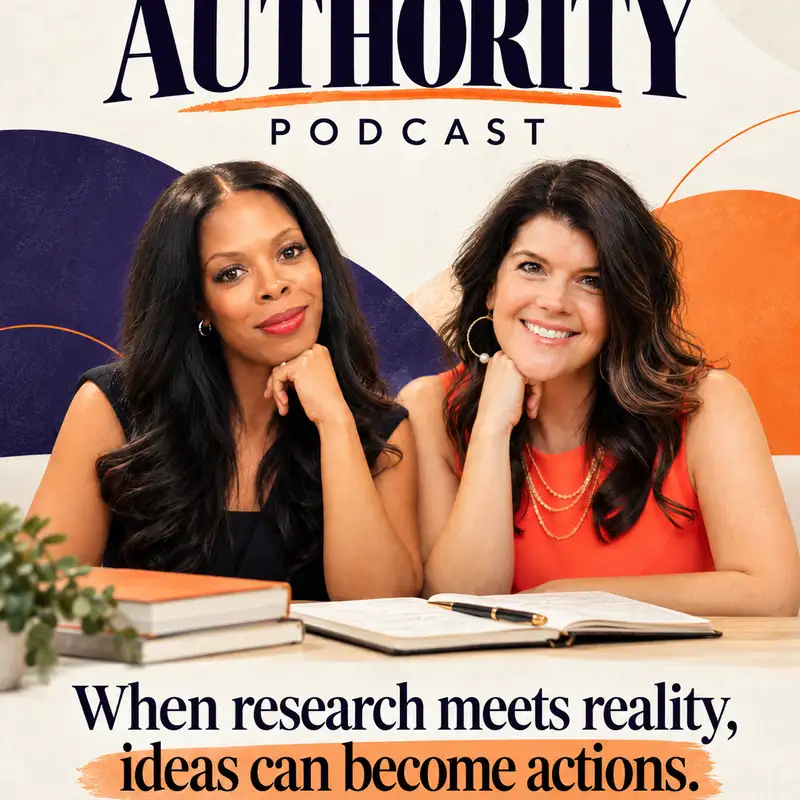
The Origin Episode of Natasha and Lindsey
Lindsey Cannon 00:00
What do you hope listeners feel is different about this next chapter of the show as we're taking over? Thanks to Ross.
Natasha Nurse 00:07
I want listeners to really hear our perspectives. We're going to be learning from leaders, and they're going to bring amazing things to the table. But I want us-I want listeners to hear how we're going to take those amazing things that authors have shared in their books and what that looks like in classrooms. How does it translate back to buildings, back to school districts? Who do
Lindsey Cannon 00:30
you think will enjoy listening to our podcast the most?
Natasha Nurse 00:32
I leaders that want something different from from their for their building, for their teachers, leaders that want to be inspired, and that not only be inspired, but they can actually, you know, create or affect change. I want our our listeners to see that we're bringing a fresh perspective. It's 2026, and what does leadership really look like? And what are the things that authors out there are writing about that can really help leaders here and now.
Natasha Nurse 01:05
So, Tasha, what's one thing that you think schools overcomplicate? Meetings. Sometimes we have a meeting just to have a meeting, or maybe communicate something that could have been communicated another way, maybe an email. Or I just think there's so many meetings and not enough time to think and unpack. I think we need to rethink what meetings could look like and should be. Nice, I like that, and I know that's something that we're hoping that those companion episodes can do is help give a space for leaders to unpack ideas. So they get new ideas in from the first episode, and then let's unpack them and really think about where where can we put these? Where can these hang and start making an impact for my staff? So describe to me your dream guest.
Natasha Nurse 01:49
My dream guest is a risk taker, someone who is not confined to just a place, someone who thinks outside of the box, and they're not afraid to think big and think small, but then think big again. My dream guest has no limits, and you know they're just so open to ideas and shaping those ideas and really getting you know affecting change. Like I'm excited about those leaders and those guests. Tell me a little more about the narrative. So you said that we are excited about the bold risk takers that are going to help change the narrative. So what needs to change about the narrative in education? What schools could actually be? We talk about innovation. We talk about inquiry. We talk about curiosity. But are we actually killing those things? Are they actually happening in the four walls that we teach in, or in the building that we're leading? I mean, I think about the the generation that we're teaching right now, and these this generation will soon take our place, right? And what are we actually doing to get to get them ready? So I arrive at that because kids don't want to come to school,
Natasha Nurse 03:01
and Lindsey, I'm not speaking about all kids, but a good number of kids see school as not a place where they're happy, but a place where they're forced to be or forced to go, and I have a problem with that. And that narrative has to be changed. The narrative of okay, yeah, we're good, but we'll eventually fix it. Well, this is the way schools were built, but we're trying to do better. We we have to do more than do better, Lindsey. This is not acceptable. I love that, and that makes me think.
Lindsey Cannon
I attended a conference and I asked the teachers what do they wish their students understood, and time and time again they kept saying, "I wish my students understood the value of their education and how important the work we're doing in schools really and truly is. And I understand what they meant, but I thought, wow, are we making sure that day in and day out the work that we're asking them is important? Does it really always have value? Because kids are great lie detectors, and if you you cannot fake it with you know I know you and I both have a middle school background, and I I don't know if it's true of all kids, but middle schoolers particularly, they they can tell if you don't truly mean what you're saying, and so is are those activities really as meaningful as we could make them, and would that help kids to buy in more if we were were really upping that that aspect of the work. Yes.
Natasha Nurse 04:22
All right. So I have a few questions for you, and I want to start with this first question. What is something people might be surprised to learn about you?
Lindsey Cannon 04:32
I think people might be surprised to learn how quickly I can adjust to a new plan. That's one of the things that I'm excited about what this podcast is helping leaders to see the how the new information that they're taking and how they can immediately start using that and so that's kind of a strength that I have is to be able to reconfigure things with new information pretty quickly and so I it is something that I've often noticed about myself I can sometimes get in trouble for running ahead so I'm hoping this is a nice place to let my ideas and my thinking run ahead of somebody to build the potential for leaders. So,
Natasha Nurse 05:07
Lindsey, you're a systems person, right? Why do you think you having that ability to be a systems thinker is so key in in education or or in any any business?
Natasha Nurse 05:18
Well, thanks for that question. Yeah, the systems thinking piece it allows the weight to be taken off of people, and a lot of times we think that we have systems because we have processes, and educators often confuse those two things: systems and processes. Processes are these are all the things that we require of you. This is the order that you go in. A system is what holds all of those processes, and I really just don't think we've gotten to that level of system thinking yet in a lot of schools, and it's going to take the weight off of any one individual, so that we can spread it out over the organization as a whole and everybody. I've yet to meet an educator that wouldn't like for the load to be lightened a little, and I think we see that at all levels. So that's really why I'm excited to help educators talk about and think through their systems and creating those.
Natasha Nurse 06:02
Yeah, thank you, Lindsey, for breaking that down and sharing. So, what, what, like, what? How are you feeling about starting this podcast?
Lindsey Cannon 06:09
Yes, Tasha, that's a great question. How do I feel about starting the podcast? Well, I'm very thankful for the foundation that Ross has already created and the B podcast network in general. I think that the show has a really rich history, and so I'm excited just to step into that. I know you and I have some ideas about how we can make it our own and add, you know, our nice little our own flavor to it, I guess. So you could say, but I'm just excited to be part of the conversation about how we do better in schools. Earlier, you were talking about we've got we've got to do better, and I think we all know that. And rich, deep conversations that are rooted in the reality of how difficult it is and the nuances of it-that's what we need. And so I'm excited to have a space where we can have those important conversations. Yeah,
Natasha Nurse 06:55
I'm excited too, and I love that this place is going to be that space. And the goal is for it to help change what people are actually doing in their buildings. So I'm loving that you're you're sharing that whole space and this podcast being that space.
Lindsey Cannon 07:12
I think you and I both hope that this podcast empowers leaders and empowers them to also empower their teachers because nothing will fix the the issues or the growth potential that we see in schools faster than people taking ownership of it and then being given space to try new and innovative things. And so, if we you talked about our guest being brave, I hope that we can help to be a bridge for the brave the the brave approaches that our authors are bringing to the table, I hope we can bridge that into tangible things that will help leaders go and be brave in their schools.
Natasha Nurse 07:45
Cannon Lindsey, I'm excited about our lineup. We've got a lot of amazing authors that will be coming to to sit with us, to speak with us, and share what you're exactly saying right now. But I wanted to ask you ask you this question: Can you be a little bit more specific in the kinds of kinds of conversations you hope to have with the authors that will be speaking with us?
Lindsey Cannon 08:07
Yes. So I I feel like everywhere in our world we often get the 15 second, 10 second sound They're great, and there are a lot of times those are really inspiring. But then a lot of times a leader can be left asking, "But how? And so I really hope we can get to that how, and to ask those questions of, "Okay, somebody's holding your book right now, and they want to start tomorrow. What's the first thing that they could do, or what do they need to consider, or if these constraints are in are in place in their school, the constraints that you and I know exist in a lot of schools. Where could they start even within those constraints? And so, really being able to start that, but how, you know, answer that, but how question for the leaders, so that the ideas are not just sounding lofty and hard to reach, but they become tangible and something that they can actually start implementing.
Natasha Nurse 08:58
Yeah, beautifully said, Lindsey. And it's important to start with a question, right? And that's a question where you can bring people together when it comes to ideas and and figuring out how to answer them. But what I love is that are the authors that we sit with or meet with, they'll be able to help, you know answer the goal, a lot of the questions that are out there. That's that's what the goal is, right?
Lindsey Cannon 09:22
We would be able to ask really good questions so that they can give those deeper ideas, so that a leader has something that they can latch onto and immediately start thinking, oh, this would work in my school. This would work in that PLC meeting, or oh this would work really good with my third grade team or my English department whatever it might be so hopefully we can do a good job of having the right questions that will that'll build those bridges I think that's the bridges from the ideas to the tangible things that leaders can begin.
Natasha Nurse 09:52
Yeah, Lindsey, I'm I'm excited because I'm thinking about our newest leaders, those that are, you know, you know, maybe principals, you know, they're running a building. They just got their job, like literally, their principal or superintendent. They have an opportunity to do something so huge. So imagine them tuning in and really being able to walk away with something tangible that they can apply right away. And I love Lindsey how you use the word bridge. We can the authority podcast can be that bridge to school districts worldwide, right? Okay, and I'm going to leave you with one last question that I have here, Lindsey. If there's one thing that you could change about education, I shared what what I think needs to change, but if there's something you could change right now, and I know you're systems thinker, what would it be?
Lindsey Cannon 10:42
I if I could change one thing about education, it would be to encourage leaders to scale back to truly think what's the most important and plan to do the most important things to the best degree that they can possibly imagine. Like if they were just to hit the top three most important things out of the park, what would that look like? And build that in first, and then fill in around that. And so that would be that would be my advice. Is let's go back, focus on the most important things, get those in our schedules and plans first, and then us, and then built around there. All right, Tasha, I'd love for you to end by telling us why are you excited about hosting with Lindsey?
Natasha Nurse 11:24
Because I love your energy, Lindsey. You bring such a refreshing energy to the world of education and just your beliefs. You you go beyond what is just there. You know, you you think beyond that, and I picked that up when I I first met you, and I knew right away that we would definitely be able to work well together. I also think that the ideas that you bring to the table are refreshing ideas. I I believe that my perspective and your perspective, they're they're not the same, but they are the same. But yet they're different, and I think that's what our viewers are going are going to want to hear how what you're thinking as well as what I'm thinking, because we're going to have different viewers out there that may really agree with you and viewers that may agree with me. But that's what makes being a human so amazing and living in a world with different people is that we all think differently, and you know. And I'm excited about that because we need to be as honest as possible, right, with what we want to share, especially when we share our companion episodes with our viewers.
Lindsey Cannon 12:32
Oh, that's lovely. Yeah, I'm excited about the companion episodes as well. I think that would be a really neat place to force ourselves to stay true to how we should plan in schools, which is putting students at the forefront and the center of that. And so I think you and I will be able to help each other with that. Like, how will that affect the students? How will that work for students? And asking that question often so that we can cut down on some of the cognitive load that our leaders are feeling all the time because they have to make these decisions all day, every day. And so, if we can create a space for them to be brave and to dream about what could be in there, and to cut down on some of the decisions that they might have to make with how to carry that out, I think that'd be a nice gift to leaders. And I'm excited to be part of that with my team. That's awesome. I am so excited to be hosting the Authority podcast with Tasha because I love the the way that Tasha doesn't really seem to be scared to tackle the hard conversations about classrooms. She's living it out every day. I know she's working on her doctorate right now as we speak, probably, and it's okay that we don't have all the answers, and she doesn't shy away from that. But she loves to get in there and say, "Well, what if and what could happen? And what about if we handle it this way? And then let's go back to the data and see what we can learn after trying it that way. And I think that's what is going to change education. And I think that's what innovation in classrooms looks like: asking good questions, diving in feet first, trying it out, and then seeing what the data tells us, and so I am excited to be able to help Tasha's perspective get out there in the world and ask her the good questions to help her thinking go deeper and resonate with people, so that everybody can reap the benefits of knowing her.
Natasha Nurse:
Beautifully said, Lindsey. Lindsay.
Creators and Guests