From Compliance to Creativity: Future-Proofing Schools with Mary Hemphill
Transcript with Dr. Mary Hemphill
0:12–0:42 — Lindsey: Welcome to The Authority, where we bring education leaders fresh ideas from authors and experts within education and beyond. We explore what their insights can mean for leadership and learning. I'm Lindsay Cannon and I'm joined with my co-host Natasha Nurse. Our guest today is Dr. Mary Hemphill, founder of The Limitless Leader. Mary's work centers on a powerful idea. Leadership is not about titles, it's about people.
0:41–1:10 — Lindsey: Purpose and progress. For more than 20 years, she has worked across education, corporate leadership, and government, helping leaders and organizations strengthen culture, improve communication, navigate complexity, and turn vision into meaningful action. Her work has been featured in Forbes and on national stages, and she brings a deeply human-centered approach to leadership development, helping leaders think not only about what they do, but who they are while doing it.
1:09–1:23 — Lindsey: I especially love that Mary talks about blending the human being with the human doing because that feels incredibly relevant to the pressures leaders are navigating right now. Mary, we are so glad to have you with us today.
1:22–1:25 — Dr. Mary Hemphill: Thank you so much, Lindsay. Thank you
1:24–1:25 — Tasha: Yes, yes.
1:24–1:28 — Dr. Mary Hemphill: so much, Natasha. It is an honor, an honor, and honor.
1:28–1:40 — Tasha: Yes. and Mary, I want to throw in there too, I want to add on to what Lindsay just said. You're the author of the one minute meeting. And this is how we met. This is how we met.
1:36–1:40 — Dr. Mary Hemphill: Yes. It is. It is.
1:39–1:45 — Tasha: it's all about creating student stakeholders in schools. And
1:43–1:45 — Dr. Mary Hemphill: Yes.
1:44–1:50 — Tasha: I'm excited as well as Lindsay to have you here on the authority. So
1:48–1:51 — Dr. Mary Hemphill: Thank you so much.
1:50–2:04 — Tasha: I first became familiar with your work in 2021 through a book study you led on the one minute meeting. And over several sessions, and we're going back, we're going back, not way back, but we're going back.
2:01–2:03 — Dr. Mary Hemphill: Mm-hmm.
2:04–2:16 — Tasha: But over several sessions, our group explored how to put its ideas about student voice into practice. And reading Future Proof, I could see Mary that same commitment.
2:15–2:30 — Tasha: expanding into a larger question about how schools prepare for change. Now, what were you seeing or experiencing that made you know that this was the book that you needed to write now?
2:30–2:56 — Dr. Mary Hemphill: Absolutely. Well, first the the I love this question and it's truly the progression that I've seen and that I've lived and walked for five years. Because when I think about the one minute meeting, at that time pre-COVID, we were truly trying to figure out how do we mobilize students, not so that we're doing education at them, but that we're doing education with them.
2:55–3:15 — Dr. Mary Hemphill: And I think that we all in education have been talking about innovation for so long that the pandemic required us to do it. And what happened to education afterwards is that I kept walking into schools, working with districts and organizations where people were working incredibly hard.
3:14–3:36 — Dr. Mary Hemphill: People were showing up. I'm telling you, they had their org charts together. Those individuals, whether it was a superintendent, whether it was a senior director, school leader, teacher leader, everyone knew what to do in their doing because they finally had permission to do something different. But all of that effort was going toward a world that I felt like no longer existed.
3:36–4:00 — Dr. Mary Hemphill: We're starting to see the job descriptions of individuals who are saying, Well, wait, they're not asking for the prerequisites and they're not asking for the resumes and they're not asking for the things that we used to do to keep the knowledge. They're asking for, can you solve this problem in real time? Do you have a wide assortment of skills that can come into our organization and maybe help us see blind spots? And truly.
3:59–4:10 — Dr. Mary Hemphill: Natasha and Lindsay, when when I started thinking about sitting down with counselors and superintendents, they were saying, Dr. Hempel, we're not just getting our students ready for college.
4:09–4:30 — Dr. Mary Hemphill: We're getting them ready for entrepreneurship and to enlist and to enroll and to follow entrepreneurial pathways. So future-proof came because I didn't necessarily want us to be so focused on the technology and artificial intelligence and cybersecurity, which is very real.
4:29–4:57 — Dr. Mary Hemphill: I wanted to make sure that the humans that are inside our system, the little ones and the big ones, had mindsets and had habits to survive what is coming. And that's my hope is that people will pick it up and say, I've been thinking about this this way because it served me well. I was rewarded when I thought this way. But maybe my students who are about to walk into the world or middle school, or maybe they're learning to read for the first time, maybe there's a new way.
4:57–5:01 — Tasha: So you saw a gap that needed
4:59–5:00 — Dr. Mary Hemphill: Mm-hmm.
5:00–5:11 — Tasha: to be closed. And that's what makes this work so your work so meaningful, Mary. Early in the book, you write that the world no longer rewards what people know,
5:10–5:20 — Tasha: educators and even building leaders, we want to make sure students are educated. But it also matters what they can do with what they know,
5:19–5:21 — Tasha: schools still.
5:20–5:34 — Tasha: Rely heavily on grades, test scores, and credentials as evidence of readiness. Here's a question I have for you. What are those measures failing to reveal about students? And you touched upon this a little bit, but we're gonna go deeper.
5:30–5:34 — Dr. Mary Hemphill: Ooh. Yes.
5:33–5:45 — Dr. Mary Hemphill: Natasha, is we can't have this conversation unless we acknowledge that we're inside of a system that's going to take time in order to ebb and flow. But I love that you elevated that gap.
5:45–5:57 — Dr. Mary Hemphill: So when we think about what's happening in this knowledge base skill base, the best way I can explain it is this gap is because the knowledge base said, be a custodian of your learning.
5:57–6:20 — Dr. Mary Hemphill: Keep it to yourself. Think about how you can store up as much of it as possible. That's where we get sage on the stage. One individual earns the opportunity to stand in front of the room, that teacher. They take all of that information, those credentials. You could sometimes those teachers have more degrees than a thermometer, right? And they've gotten all this opportunity to say, now I can impart to you what I know.
6:20–6:45 — Dr. Mary Hemphill: And I'm going to find a way, standardized assessment, formative assessment, for you to say, give it back to me. But the skill-based economy, and I talk about this in the book, requires the gap to be curated. So instead of a custodian of knowledge, we're curators of knowledge, meaning Lindsay's lived experience, her opinions, the things and the way that she ebbs and flows through the world get to come into the classroom.
6:44–7:09 — Dr. Mary Hemphill: And if I say that this one standardized assessment that Lindsay took on a Friday morning at 8 a.m. is the total encapsulation of the beauty of who she is, how she shows up, and the gifts she can pour into the world, then I'm missing the opportunity to experience Lindsay in a 360 experience. What I'm asking for, and in that gap.
7:08–7:19 — Dr. Mary Hemphill: is for teachers to say, yes, I have this baseline assessment that says I understand where this child is with literacy and reading and writing, but I also took the time.
7:18–7:49 — Dr. Mary Hemphill: To say this individual has such amazing skills of innovation or maybe technology or maybe they have the gift of storytelling, which you can't capture by circling in A, B, C, or D. And so because I'm a curator, I'm gonna curate more opportunities where that child is not like, well, I'm a level two. No, you are a level two, but you're a fantastic storyteller and you're amazing when it comes to creating belonging. I saw what you did on the playground when that one individual didn't get picked for.
7:48–8:07 — Dr. Mary Hemphill: the team and you bumped them in shoulder to shoulder and you said, come be a part of my team. Because just in that one exchange, Natasha, I didn't negate what their intellect, I integrated their intellect into the experience that I curated around learning.
8:07–8:15 — Tasha: That is definitely powerful. You saw, Mary, what was already there, what already existed. and you
8:13–8:15 — Dr. Mary Hemphill: yes.
8:14–8:28 — Tasha: you got your educators, your building leaders to see that, hey, if you add this with what you already have, we can make greater changes. That leads me, Mary, into your five pillars of your framework.
8:27–8:29 — Dr. Mary Hemphill: Yes.
8:28–8:39 — Tasha: your five pillars are really, what lays the foundation of your work. Curation, connection, collaboration, communication, so talk to us about your framework.
8:38–9:02 — Dr. Mary Hemphill: the one thing that I also have noticed is as I was doing this work and we're asking, how are we preparing students for a future that, Natasha, we don't know what it's going to look like. We don't know how heavily nuanced it's going to show up. So we know that schools and districts are in different places. So the five C's are not only cyclical, but they're living and breathing.
9:02–9:22 — Dr. Mary Hemphill: It starts with curation. And I did that intentionally because when I introduced it to school leaders, I took three years of just working with different districts, different opportunities, and leaders at every level to really say one thing. If you go to a museum and let's say they're boasting a brand new collection on dinosaurs.
9:22–9:35 — Dr. Mary Hemphill: There has been so much work and effort and intentionality that has gone into how are we going to label this particular display and what do we want people to experience as we walk through it.
9:34–9:55 — Dr. Mary Hemphill: And I think that we have been performing school for so many decades that we know we have systems that work. We know how to take the roll and the lunch count, and we know how to roll out PD, and we know how to do the summer conferencing. But curation asks a simple question and it says, How do I choose what to carry forward?
9:55–10:19 — Dr. Mary Hemphill: Because we don't want to dishonor tradition, we don't want to dishonor the multitude of decades of veteran educators and superintendents and all the leadership that has poured into what we're building on now. But curation also asks the other question: what do I need to release? Because it's too one, it's too heavy to shoulder the burden right now with the human capital I have, but also.
10:18–10:41 — Dr. Mary Hemphill: Is this deeply relevant for the world that these children are about to walk into? And when you get to decide, you get to take stock and inventory of what is already happening in your environment. So then we're starting with curation so that we can move to connection. We all know that over the past five years, people have walked through deeply traumatic.
10:41–11:06 — Dr. Mary Hemphill: deeply empathic and opportunities where it has caused us to really become one with ourselves. This whole idea of self-care has taken off and I hope that schools are embracing community care and so that children can see how to connect. But connection is what's the relational architecture of my building? One of the things I have school leaders do is to walk through their building and do a wind walk.
11:05–11:24 — Dr. Mary Hemphill: How many ways do you celebrate winning in your building? And not just because it's a star quarterback or the student who always makes straight A's. Are you finding the student who maybe graces the principal's door because of behavior, but finding the one thing that he's positively leading in his experience? That's connection.
11:24–11:53 — Dr. Mary Hemphill: And then saying in this relational architecture, what do I want it to feel like when I'm walking in the hallways and when I'm going in classrooms and when people talk about my school on a Saturday night at the piggly wiggly? That's connection. Collaboration is the next step because then you're designing systems, Natasha, so that leadership doesn't stay to the top. The only thing that's good at the top is when you're thinking about seeing that 30,000-foot world view.
11:52–12:18 — Dr. Mary Hemphill: I would always tell my staff, are we bringing in the custodians? Are we bringing in the cafeteria managers? Did we bring in the kindergartner who came in mid-year and asked them, what was your experience like? Was it haphazard or was it intentional? And yes, a five-year-old can tell you if they feel as if they belong in a space. That's collaboration. And it's saying, are you putting the people who are closest to the work?
12:17–12:27 — Dr. Mary Hemphill: in the room where you make the decisions about what's going to happen to them and their learning. That fourth step is communication. And we can't
12:25–12:26 — Tasha: Yeah.
12:26–12:29 — Dr. Mary Hemphill: talk about communication if
12:28–12:29 — Tasha: Yes.
12:28–12:36 — Dr. Mary Hemphill: we don't really say inside of this communication, am I translating trust across every audience?
12:35–12:59 — Dr. Mary Hemphill: Because trust for a new teacher who is fresh out of school, who has decided to go into education looks different than trust for a veteran educator who has spent 25 years pouring into her craft. And I saw a quote, Lindsey the other day, and it said, trust arrives with care, but it leaves on horseback.
12:59–13:19 — Dr. Mary Hemphill: And when you think about the fact that we're so careful with when we interview and when we have a new parent or when we're an acclimating a student to a new program. But what we forget oftentimes is that trust in one moment, one micro interaction, one thing that's said, one bad day, that's the thing that people talk about.
13:18–13:37 — Dr. Mary Hemphill: So I as say in communication, is alignment translatable for your teachers, for your seventh graders, and for any staff that's walking in. And then this last one, and this is where we all will remain, I feel like, for the next couple of years for sure, is calibration.
13:37–13:55 — Dr. Mary Hemphill: You'll know when you take your car and you go get your tires rotated and they say, Okay, wait a minute, we have to calibrate the tires because we need all four tires moving and working together. Well, calibration is the leader stepping back and saying, I realize I'm gonna be in beta because there's all this information that I don't know.
13:55–14:23 — Dr. Mary Hemphill: Do I have the patience to responsibly adjust my own decisions, my own habits, even if we've spent all this time on it, but we're finding that it's not good for children or it's not working for adults. Because calibration says out loud, I'm willing to readjust the thing because I have new information. And so we can't keep saying, if we know better, do better, if the do better is always the thing left off.
14:23–14:32 — Dr. Mary Hemphill: And the thing about the five C's is that after you calibrate, you're right back at curation because then you're deciding, do I release it or do I hold on to it?
14:32–14:40 — Tasha: I'm thinking about everything you said with the five C's. When leaders are under pressure, which pillar do
14:37–14:40 — Dr. Mary Hemphill: Mm. Yes.
14:39–14:42 — Tasha: you think they're most likely to neglect?
14:43–14:47 — Dr. Mary Hemphill: Calibration for sure. Because pressure
14:45–14:47 — Lindsey: Okay.
14:47–14:58 — Dr. Mary Hemphill: tells us a couple of things. Pressure tells us that the system has reached maximum capacity. So if the school leader, if that pressure is coming from the board.
14:58–15:26 — Dr. Mary Hemphill: See, that's a different pressure because then you have to interplay the micropolitics. You have to think about who's close to this decision. What does this decision mean, not just for the group I'm looking at? What's the echo effect that it could have on other groups that may not have just had the resources to come to the table? But the pressure, too, comes from the system of we've always done it this way. And what I'm asking in this book.
15:25–15:48 — Dr. Mary Hemphill: Particularly when you begin to think about the fact that the future is highly unpredictable. Sometimes to go first takes so much courage, takes such a risk that we want to go back to the thing that, of course, worked for us the last time. But without calibration, you don't give yourself permission to say, I can't Google.
15:47–15:56 — Dr. Mary Hemphill: what is my school going to look like in 2030? No one knows, not even Google. Chat GPT, Claude, nobody knows, right? That's why this work
15:53–15:54 — Tasha: No.
15:55–16:02 — Dr. Mary Hemphill: is so deeply human, because I would rather have a principal who operates with discernment and pressure.
16:01–16:11 — Dr. Mary Hemphill: Than a principal who operates off of just the what-ifs, the uncalculated, I'm gonna assume, because that principal
16:09–16:11 — Lindsey: Mm-hmm.
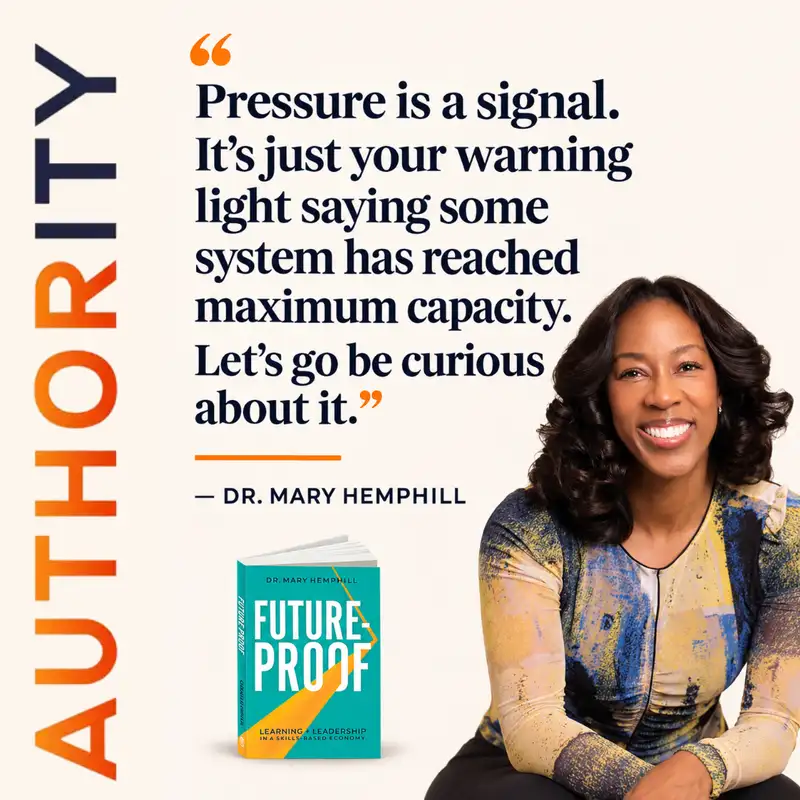
16:10–16:32 — Dr. Mary Hemphill: is the one person who's at the epicenter of it all on a day-to-day basis. That teachers right in that classroom on a day-to-day basis. So that pressure, I hope people will begin to think about pressure as a signal. It's just your warning light saying some system has reached maximum capacity. Let's go be curious about it.
16:31–16:39 — Dr. Mary Hemphill: We don't have to fault it. Let's just be curious and let's be curious about it together so we can find a new way to do it.
16:38–16:43 — Tasha: Lindsay, you speak a lot about curiosity and exactly what Mary is saying.
16:43–17:04 — Lindsey: I really think so few schools actually ever get to that calibration. I think that a lot of times we spend so much time and the beginning of rolling things out and it feels like progress to us because if we are adopting a new curriculum, let's say, ~ it's got a new set of language with it, it's got new posters, it's got new
17:04–17:18 — Lindsey: ~ ~ binders and data collection and all the things. And it feels like progress to us. But honestly, all of that is are those first stages that you're talking about where you're curating and deciding what you're going to keep and what you're going to use. And then how are you going to communicate these
17:17–17:18 — Dr. Mary Hemphill: Mm-hmm.
17:17–17:28 — Lindsey: changes? And then once we get all of that laid, then it's time to really start doing the fine tuning, calibrating. And I just, I feel like a lot of times
17:27–17:52 — Lindsey: When it's not perfect at that stage, then we think, well, we've needed a different curriculum or we needed a different initiative or we needed, and then we just keep starting over. So I would love, ~ what are some indications maybe for leaders where you're not on the wrong path? You're just not all the way finished. So what are the indicators for a leader to know when keep going, you're on the right direction, just keep going.
17:51–18:11 — Dr. Mary Hemphill: Absolutely. Well, I'm gonna start, and I love this example, Lindsay. I wanna start with people. One of the indications, and I think that this is happening across industries, but particularly in education, first is do you have intergenerational dialogue that's authentic and that is collaborative?
18:11–18:37 — Dr. Mary Hemphill: Lindsay, we cannot afford to lose the best and the brightest of our teachers, one that are coming into the industry and two that have poured so much wisdom and have so much historical knowledge. So one of the key things that I always look for and I ask leaders to look for is are your beginning teachers, do they have a natural bent and are they welcomed and experienced belonging when it comes to your staff as a whole?
18:36–18:55 — Dr. Mary Hemphill: Meaning, when we start to think about what's possible for teachers in the future, do they say, okay, I have an open door policy, come ask me questions all the time? Or do we often see those ~ veteran teachers always in their classroom behind closed doors holding all that historical knowledge?
18:54–19:17 — Dr. Mary Hemphill: Or are you setting up staff meetings where instead of saying, let's go around and do celebrations, instead have your brand new teachers, your brand new staff stand up and say, Now I want our veteran teachers, or you've had two or three more years in this building, I want you to go walk with them around the building. Why? Because research says that human beings are supposed to solve problems at three miles an hour.
19:17–19:41 — Dr. Mary Hemphill: And so what I do is I encourage beginning teachers, ask the question that you haven't been able to ask since you since you arrived. Maybe it's about the copier, maybe it's about why we do this one thing for drills, maybe it's that you you taught a math lesson and it tanked, but ask the thing. And veteran teachers, I want you to open up your minds and do your think aloud in front of that new teacher, in front of that new staff member.
19:41–20:09 — Dr. Mary Hemphill: Because we need more new leaders to be with leaders who have survived the thing so that that new leader has more longevity. And so when I see a leader who's open to doing that, that's how I know, Lindsay, that they're deeply curious or that they're ready to say, okay, we can do this a different way. The other thing I see a lot of times too is in evaluation. And I think the knowledge base economy has asked us for a lot about what do you know?
20:09–20:35 — Dr. Mary Hemphill: And I see it all the time outside of a teacher's classroom, where they went to school, what they're credentialed in, how many years they've been teaching. But see, future proof says, what do you do when you don't have the answer? Because see, the child is sitting in the classroom and they're thinking, okay, this information has been given to me. I need to be able to either answer the test or answer the question or finish the project or whatnot, or what have you. But I'm
20:34–21:01 — Dr. Mary Hemphill: For during that observation, when the teacher doesn't know something, or when the student asks that one question that the teacher is not necessarily prepared to answer, what's the learning path created, and what's the feeling around unknowing? Is the child belittled or made to feel small? Does the adult shrink because they don't know? And ~ ~ ~ ~ sometimes we carry that onus of I don't know, I can't draft, I can't believe I didn't prepare for that.
21:00–21:28 — Dr. Mary Hemphill: If, as teachers, one of the signals that we remember is that it's not about us knowing all the answers. It's about us creating safe, graceful pathways for the child to be able to get there when they have that moment. So when I think about some of those signs, I'm looking for openness, a posture of curiosity, grace for staying in beta. And if we don't know same, what's the next thing that we can do to find out without shame?
21:27–21:38 — Dr. Mary Hemphill: Because clarity without cruelty is how we start to build healthy schools with healthy learners who are deeply curious and want to run toward their purpose.
21:38–21:44 — Lindsey: I love that so much. I do have one more question and then I'll turn it back to Natasha if that's okay. So one
21:40–21:42 — Dr. Mary Hemphill: Okay.
21:42–21:43 — Tasha: Yeah.
21:43–21:46 — Lindsey: thing that you said in that the questions. So
21:45–21:47 — Dr. Mary Hemphill: Mm-hmm.
21:46–21:54 — Lindsey: for a leader, sometimes it can be daunting because people do bring up questions that we really don't have answers to. And where
21:52–21:54 — Dr. Mary Hemphill: Yes, yes.
21:53–22:05 — Lindsey: we, I mean, there's a lot of questions around how to ~ invite students into learning that we're still figuring out as an entire industry. And so when people bring those questions up.
22:04–22:25 — Lindsey: You don't have the answer. So how do you navigate that? Because like you said, ~ ~ we're leading in a world that changes so quickly that what worked 10 years ago isn't the answer now. So we know that's not the answer, but we've yet to find the answer. So how do you navigate that gray area and still feel like a leader and and feel feel like you're in doing your leadership job well?
22:24–22:51 — Dr. Mary Hemphill: Absolutely. And I think when you begin to think about that coming from a teacher or a student, I think that they're deeply similar. One of the things that we understand about the future, understand about leadership, is moving away from this idea that the leader has to carry all the answers. And I'm gonna say this because it connects back to what Natasha just asked me about pressure and stress. If we believe that as the school leader, I'm supposed to posture myself as an all-knowing being.
22:51–23:18 — Dr. Mary Hemphill: That is deeply stressful. And there's pressure that's attached to that that filters through our responses. So if I'm coaching a leader and they bring to me and they say, Hey, I had a staff member who asked me a question and I literally had no answer. I always say, Okay, if you were to take this opportunity and position your answer inside of your credibility, what could you connect it to? And what it could look like potentially is saying,
23:17–23:45 — Dr. Mary Hemphill: First of all, I want to thank you for the courage of elevating that question. I want to meet your curiosity with the authenticity of saying, can I partner with you on this journey? Because while I don't know the answer, I would love to figure out how we can create a pathway to get to that answer. And it's going to require more information than I think that we're able to glean in this moment. Let's absolutely set up a time to do a 20-minute deep dive. And see, here's the other piece.
23:44–24:07 — Dr. Mary Hemphill: When we think about research, it's very easy to tell that teacher, Google it, go ask AI, put it into Chat GPT and get a response. But if as a leader you believe you train people how to treat you, then you're outsourcing the opportunity for human and cognitive friction. Friction is what makes us feel alive.
24:07–24:37 — Dr. Mary Hemphill: When you say I'm willing to jump in the boat of unknowing and unlearning with you, what you're saying is that not only am I leading the path, yes, but I'm also going to be authentic. I'm going to be transparent and I'm going to be honest with you in terms of how we get there. Because Lindsay, it may be as simple as asking Google. It may be as simple as asking AI. But if I stop there, I miss the human connection of experiencing finding the answer together.
24:36–24:47 — Dr. Mary Hemphill: And one of the things I always liken it too is, I don't know if you ladies remember Encyclopedia Britannica. ~ I loved it, right? I couldn't wait for the new edition to
24:44–24:46 — Tasha: Yes, yes, yes.
24:46–24:53 — Dr. Mary Hemphill: arrive at my house. But I was giddy about the new edition because the new edition had new information.
24:53–25:24 — Dr. Mary Hemphill: That was an experience. If we want to recreate this experience for leaders, particularly when we're faced with something we don't know, we can't just say, I'm going to outsource the experience to technology. No, I'm going to create the experience with you, which means we may need to find a book. We may need to ask AI, but then we need to discern the answer together and have some conversation. We may need to go get another individual who has way more expertise and way more knowledge and let's have a conversation. Because a checklist isn't going to answer this question. Conversation is.
25:23–25:35 — Dr. Mary Hemphill: But if your aim is to put the human back in the center, you can't have a wrong answer. But it's just you doing it out loud and doing it in front that makes you that leader.
25:35–25:45 — Lindsey: Thank you for that. I love that. I think the finding the answer together and the power that happens in that I hope that all the leaders listening are grabbing the nugget because I think that one's really valuable.
25:44–25:45 — Dr. Mary Hemphill: Thank
25:44–25:46 — Dr. Mary Hemphill: you, thank you, thank you.
25:46–25:53 — Tasha: I want to move this conversation to students now. Now you speak about Trevor, And your
25:51–25:52 — Dr. Mary Hemphill: Yes.
25:52–26:01 — Tasha: story about Trevor State with me. He had taught himself 14, not two, not three, not four.
26:01–26:08 — Tasha: But 14 programming languages outside a formal classroom. And
26:04–26:07 — Dr. Mary Hemphill: Mm-hmm. Mm-hmm.
26:07–26:20 — Tasha: you describe realizing that your own definition of learning needed to change. So if students, Mary, can develop expertise that the adults in the school do not have, how
26:18–26:19 — Dr. Mary Hemphill: Mm.
26:19–26:25 — Tasha: should that change? Who gets to lead and who gets to teach?
26:24–26:27 — Dr. Mary Hemphill: I love this. I love
26:26–26:51 — Dr. Mary Hemphill: this question. Who gets to lead and who gets to teach? And I I truly believe that this is about knowing yourself. And I I always share the Trevor story because when I say, ladies, I was so sure that he was about to hit me with Mandarin or Portuguese or just some language that in my head was going to give him access to new people and new cultures and whatnot.
26:51–27:15 — Dr. Mary Hemphill: But when he said the computer languages, I was met with my own unlearning. And so what I think is when we begin to understand that self-awareness, meaning I have a way that I have moved through the world, I have a way that I was raised, right? If you're like me, I love I love that they now call us elder millennials. That just makes me feel great, right? Elder. But when you think about
27:14–27:37 — Dr. Mary Hemphill: Reading, writing, and arithmetic pretty much as the underpinning and foundation of what you needed to move forward. We also have to, along with that self-awareness, understand that the Trevors of the world are expanding our definition of success. And ladies, I think that that's where future proof really comes in because.
27:36–28:07 — Dr. Mary Hemphill: Success is no longer measured by how many degrees or how many years or knowing all of this information. It is in this moment, what can I glean and do I know where to go to get the skill so that I can then create an arsenal of talents that may look like a multi hyphen, that may look like an individual who has multiple likes and dislikes just across a diaspora of industries, and saying instead of being a doctor, a lawyer, a candidate.
28:06–28:07 — Dr. Mary Hemphill: Candlestick
28:06–28:23 — Dr. Mary Hemphill: maker, whatever. Where can we go so that your purpose and your proclivities have a way that they can be lived out? For Trevor, he just happened to be in that moment a student who was excited about putting a new tool into his arsenal.
28:22–28:47 — Dr. Mary Hemphill: I was putting him in a completely different box that no longer existed. So when you say who's the teacher, who's the leader, when we are able to swap roles, and for me in that moment, I had to sit at Trevor's feet and be not the sage. I had to be the student. Because when he said, Dr. Hempel, I learned these off YouTube. Doctor Himpo, I was able to practice these and whatnot, in my mind,
28:46–29:00 — Dr. Mary Hemphill: Formal curriculum is not YouTube. But to our children, YouTube is a pathway for them to glean information. Now, is all of it true and credible? I think that's a different podcast. But them gleaning
28:59–29:00 — Lindsey: Mm.
28:59–29:16 — Dr. Mary Hemphill: that skill and bringing that into this conversation. Because right now we have students who have access to this. They've computer languages, all types of cybersecurity analysts. And I'm talking about STEM careers, but just as much baking and fashion and healthcare and art.
29:16–29:28 — Dr. Mary Hemphill: And so now the question has to say, not just teacher or leader, where's the container that I put all of this energy and passion? Because it may be a six-point lesson plan and a performance.
29:28–29:57 — Dr. Mary Hemphill: It may be the best curriculum unit that we have, and it's going to be that we have a student panel where parents and teachers sit in the audience and it's moderated by a student. We take questions from the students and we listen to how they answer and we as adults step back and watch how they communicate and how they collaborate and connect and take that information back to our boards. And so it's simply going to mean in the future that basically we're sitting at a seat.
29:56–30:21 — Dr. Mary Hemphill: Am I the only person who can occupy that seat? And the and the answer to it that we're seeing is whether it's Trevor or whether it's Sandy or Amai or any of the students that I talk about in the book, it's the fact that our students are not only capable of taking the reins, but they're capable of sitting down at tables and they're absolutely capable of articulating what is happening to them in their educational trajectory, period.
30:20–30:31 — Tasha: So the future's now. If we, if we it it's right now. I mean, we we can't deny it. And it and if you work, you know,
30:23–30:28 — Dr. Mary Hemphill: The future is right now. Absolutely. Absolutely. Absolutely.
30:30–30:39 — Tasha: if you're in a classroom as an educator or you're a building leader, the future is now. There's so much talk, Mary, about AI
30:36–30:39 — Dr. Mary Hemphill: Mm-hmm. Mm-hmm.
30:39–30:45 — Tasha: and how, we have to get ahead of AI or AI is taking over our students' thinking.
30:44–30:53 — Tasha: how can leaders tell whether AI is expanding student agency or simply helping students produce more polished work?
30:52–31:16 — Dr. Mary Hemphill: This is a good one. And I'm gonna say I believe, and I would love to to hear everybody's answer, but I honestly think it's the level of rigor in the conversation that happens after the output. And I just gave you an example of this in terms of a leader not knowing the answer and then outsourcing it to technology. That is where the experience stops.
31:15–31:35 — Dr. Mary Hemphill: But what I'm looking for, and I went to an amazing session at model schools last year about writing in the age of AI. And it was led by two AI futurists, Misty and Naomi. And they absolutely did a wonderful job of talking about writing as a tool to translate understanding.
31:34–31:59 — Dr. Mary Hemphill: But what they said and what they offered is a whole set of discernment questions that after students have engaged with artificial intelligence, let's say the teacher gave them a prompt or a question or whatnot, they take that output, close the device, and they work through this set of discernment questions. Everything from does this output sound like my natural speaking voice?
31:58–32:25 — Dr. Mary Hemphill: Does this output utilize vocabulary that I would use on a regular basis? And would I feel comfortable describing or defining some of the words used without the use of other technology? Could I explain this answer in a completely different way to a different audience if given the opportunity? Just those discernment questions alone allow the human to be back in the center of that cognitive friction that I talk about.
32:25–32:54 — Dr. Mary Hemphill: And so I think that, Natasha, it's us teaching, we're teachers, we're leaders. We have to teach them to be able to say, what's the pause where you say, I can be digital, but it's going to take this analog process of asking myself discernment questions or curiosity questions or metacognitive questions, so that the output has feet and legs. And it's something that I can, own, I can tweak, I can revise, or
32:54–33:20 — Dr. Mary Hemphill: I can reject because I think that's the other piece that we have to teach students to be able to do. You can reject an output if you believe it doesn't pass the discernment check or the purpose check. And so when these things are taught responsibly, and here's the other thing that I often teach leaders to do, when it's practiced out in front, we have to remember AI is new for everybody.
33:20–33:49 — Dr. Mary Hemphill: It's changing in the time it'll take us to have this conversation, something about AI will be created and something will be rendered defunct. We're practicing leadership because the version of our leadership this week may not look like the version of our leadership next week, just because the situations have changed. So one thing I always say is let's practice our thinking on this. I want us to utilize these discernment questions to practice the outputs, practice our thinking, and practice revision.
33:48–34:08 — Dr. Mary Hemphill: And when you say practice, do you know what you're giving your students immediately? Permission to not be perfect. Because if we hold an idea of perfection over our students' head in the future, we will just have a generation of students who believe they have to be deeply compliant when we really need them to be deeply creative.
34:08–34:15 — Tasha: That's the beauty of the messiness of learning. allowing students to become messy
34:13–34:14 — Dr. Mary Hemphill: exactly.
34:14–34:16 — Tasha: and then clean it up, Together,
34:16–34:24 — Tasha: As a whole. Boom, done. Boom. They call it a mic drop. So,
34:16–34:23 — Dr. Mary Hemphill: Boom. Boom. I love that. I love that you said that. Exactly. Exactly.
34:20–34:22 — Lindsey: Yeah.
34:23–34:35 — Tasha: Mary, before we close, we've had such a wonderful conversation. we're so excited about your new book that's about to drop. I want to return to the leader who's listening right now.
34:35–34:36 — Dr. Mary Hemphill: Mm.
34:36–34:47 — Tasha: Who may feel so consumed by the demands right in front of them? What's one question that a leader can ask tomorrow to begin future proofing their school?
34:46–35:04 — Dr. Mary Hemphill: ~ I love this. when I think about leaders right now, I know what they're up against. I know what they're facing. But I also know that the leaders who are leading in this moment, like you said, the future is now, are the ones who are gonna be creating the blueprint for what's going to come.
35:03–35:27 — Dr. Mary Hemphill: And so the one future-proof question that I ~ ~ always lead with and interject is: what are students and staff able to build? And what are they able to sustain on their own? Because, see, here's the piece. If the leader has to be in the room to give the work life force, if the leader has to be in the room to give the leadership or the learning permission.
35:27–35:58 — Dr. Mary Hemphill: Then that is still a deeply compliant system. That's do as I say. We need leaders to create other leaders, teacher leaders, student leaders, staff leaders, who say, based on what I know about excellence in this building, based on what I know about the support and the permission I've been given to be my best creative self in this building, I can trust that when I shift this lesson plan for the greater good of students, when I sit down and let a student take the mic.
35:57–36:19 — Dr. Mary Hemphill: When I go to my neighbor and ask for help, I'm not going to be looked at any differently. I'm not going to be ostracized or retaliated against. I'm not going to get that side eye, the staff meeting. I'm going to be deeply embraced. I'm going to be deeply understood, but I'm also going to be safely held in the process.
36:19–36:43 — Dr. Mary Hemphill: Whether I'm in process of learning or whether I'm in the process of leading, I'm safe to do that regardless of who's standing, evaluating, watching. Because here I know that it's learning and leadership that are prioritized over perfection and compliance. Because if they can do that on their own, they're doing that on the playground, hallway, the bus stop.
36:42–36:52 — Dr. Mary Hemphill: the YMCA, the local facilities and community centers, that's when school becomes not just brick and mortar, becomes community.
36:51–37:12 — Tasha: You're giving me chills, Mary. everything that you're saying, I feel it. And it's real. And, you know, we just want to thank you. We want to thank you. You've given Lindsay me so much to continue thinking about. And we're really looking forward to unpacking this conversation in our companion episode. But I
37:09–37:11 — Dr. Mary Hemphill: So excited.
37:11–37:17 — Tasha: I think it's important also to let people know where they can find future-proof?
37:17–37:19 — Tasha: and continue learning with you.
37:18–37:34 — Dr. Mary Hemphill: Absolutely. Well first I just want to say thank you. Thank you for having me. I am beyond honored, but I'm also excited about what you two are building. So thank you for creating this space and thank you for being exactly who you are and pouring into all of us as leaders.
37:33–38:04 — Dr. Mary Hemphill: Everyone can find us at bealimitlessleader.com. If you go there, there's a future proof page with all of the information, it'll be updates. Future proof is also available on Amazon, and you can always follow our work and announcements. If you look for Dr. Mary Hempel on LinkedIn and on Instagram, you can find a lot of fun things coming out, and we're really excited. Our study guide will be available here next month as well for the book. So, again, just thank you. And I I'm just so deeply honored to share.
38:03–38:05 — Dr. Mary Hemphill: Share this message on your platform.
38:04–38:11 — Tasha: We are too. We are very honored. Lindsay, I'm gonna turn it over to you to close us out.
38:07–38:12 — Lindsey: Yes. Thank you so much for joining us. Well, I just want to thank those that
38:11–38:28 — Lindsey: tuned in with us today. I just wanna thank them for joining us on the authority and make sure you catch the next episode where Tasha and I will be unpacking these ideas and connecting them to something you can immediately start implementing in your schools and classrooms in our next episode. Thanks so much, guys.
Creators and Guests