How Gratitude Can Help Educators to Combat Burnout with Lainie Rowell
Lindsey (00:06.476)
Hi guys.
Lindsey (00:36.008)
Welcome to The Authority, where we bring education leaders fresh ideas from authors and experts within education and beyond. We explore what their insights can mean for leadership and learning. Hi, I'm Lindsay Cannon.
Tasha (00:50.789)
And I'm Natasha Nurse. Our guest today is someone I am especially happy to welcome: the one and only Lainey Rowell. Lainey is a best-selling author, award-winning educator. She's presented in 41 states. Her work has also reached audiences in dozens of countries across four continents. She's a TEDx speaker whose clients have included Apple and Google.
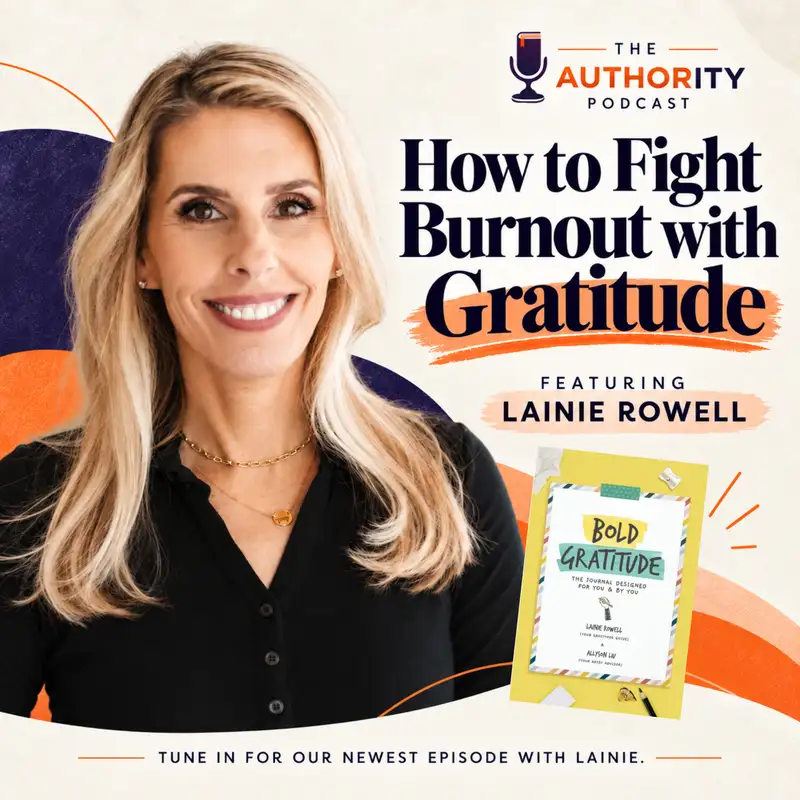
Lainey also works with school systems throughout the world. She wrote Evolving with Gratitude and served as a lead author of Evolving Learner. And her latest work, Bold Gratitude, the journal designed for you and by you, invites readers to create a gratitude practice that feels personal rather than prescribed. I first connected with you, Laney, through our mutual friend Lauren Kaufman.
2023. And that same year, I had the privilege of joining her on the Evolving with Gratitude podcast. And it just feels so meaningful to welcome Laney, welcome you, Laney, to our podcast today. We're so happy to have you with us.
Lainie Rowell (02:08.444)
Well, I'm just thrilled to be here with both of you. I'm super excited for the conversation and let's get to it.
Tasha (02:17.103)
So so, Lady, even after knowing you and following your work, I realize that there's something I've never really actually asked you ever.
Lainie Rowell (02:27.386)
Ooh, that's intriguing.
Tasha (02:29.188)
Yeah, I I I I need to know this. Where did your relationship, Lainey? Where did your relationship with gratitude begin?
Lainie Rowell (02:37.756)
Mm, that's a I love that question, especially because I I'd like to think that I have been grateful throughout my life. I would like to to say thank you to my parents for being good models of a grateful disposition. But I would say that my relationship with gratitude was somewhat surface level until something happened that it's gonna sound like a champagne problem.
But my very first book, Evolving Learner, actually came out on March 13th, 2020. And for those listening, if that doesn't ring a bell, for a lot of us, that was the day that we locked down for COVID-19. And so that was the first day of shutdown for a lot of us. So again, a champagne problem. I got to put a book out into the world, but when you spend five years on something, you don't want the launch day to be the day the world is shutting down. So with so much appreciation, there were more important things going on.
I was not in a good place. I was, you know, on top of just the worrying about humanity, it was also this personal goal that I had, you know, just reached and it wasn't gonna be what I wanted it to be. So then I spent like I spent some time wallowing, I think, which was fair for all of us to do. It was a very difficult situation. And then about six days into shutdown, I came across this Lori Laura Canel.
Cut, sorry. I came across this Laura Kelly Finucci poem and it's called When This Is Over. And it's When This Is Over, May We Never Take For Granted, Handshakes with the Strangers, Full Shelves in the Stores. And so that was a big that was a pivotal moment that completely changed my life because I realized that there was something really hard going on, but there were still good things going on. We had enough food to eat in the house. I was with my family, no one was sick, and
There it's not about ignoring what's hard. It's about refusing to overlook what's good. And that was really when my relationship with gratitude changed. And I went into I can tell tell you all about it because I went into like the research and all of that because I really wanted to know more about how how have I overlooked something this important.
Tasha (04:55.58)
Love that real Laney, can you repeat that again? You said refusing to overlook something that's
Lainie Rowell (05:01.852)
Yeah, because you'll you'll hear that people you can hear people sometimes say, that sounds like toxic posity. And so if I if there was one thing I would love for people to take away from what I have learned from gratitude, is it's not overlooking what's hard. It's refusing to overlook what's good. And there's a difference. There's a real difference there. And so that's what that's what I'm focusing on.
Tasha (05:27.314)
Powerful. I'm gonna turn it over to you, Lindsay. Powerful. Thank you for that.
Lindsey (05:30.95)
yes, I love that so much. Refusing to overlook what is positive. I do I think that could be a huge takeaway for a lot of people. So I love that the book had quotes in it. And so my first question for you, the Oprah Winfrey quote where she reminds us that we need to focus on the good, which really ties into what you were just saying. The refusing to to overlook the good. So why did that quote make it in the journal and why
Why is it so powerful to focus on the things that are good, even when things that are not so good are also present?
Lainie Rowell (06:01.693)
Well, because we come and and there's so many so many quotes in the journal. See, I had to have my copy in case you guys tested me, I had to have my copy handy. But there the quotes in there are strategically placed based on where you are in the journal, because you know, the first part of the journal is like really about connecting to ourselves and then it's like with peers and then it's the world. And the reason that we have to be
Tasha (06:11.101)
Mm-hmm.
Lainie Rowell (06:27.985)
intentional and we want to cultivate a grateful disposition is that we are all born with a negativity bias. You you you've probably heard this already, right? So it's a very important reason that we have the negativity bias. So I don't want to completely say like boo on negativity bias. Like the reason that we have it is to keep us safe. But the reality is most of us are not in a constant state of being
attacked or we're not we're not really at risk all the time like we were, you know, hundreds of thousands of years ago. So that negativity bias is an evolutionary ab adaptation because it's what keeps us from doing things that could hurt ourselves. But it's so overactive that we tend to just notice those bad things. And it's like overwhelmingly noticing the bad. And when we practice gratitude, we are
Being intentional on focusing on what is good.
Lindsey (07:27.585)
Wonderful. And I would love, so this, you know, we really envision this podcast being a place where leaders of schools can come and get ideas. So let's pull that into a school setting because we know, unfortunately, there's a lot of times where we can focus on what we don't have or what's not exactly the way that we want it to. So what advice would you give leaders in schools trying to do that?
Lainie Rowell (07:49.332)
Well, I mean, I think this is you you both know this, your listeners know this as educators modeling is like a huge thing. It's just there's no getting it's like common sense, but it's also there's no getting around that. And the one most actionable thing that I advocate for in schools, based on the research, is a form of gratitude, is praise. And I like to talk about the praise to correction ratio. Tasha's heard me talk about it before. I can't stop talking about it because to me it's just one of the most
Tasha (08:14.301)
Yes, yes.
Lainie Rowell (08:18.867)
practical and actionable ways to make gratitude work well in a learning environment. And so let me just level up on what I mean by praise, because I'm not talking about vapid praise. I'm talking about specific, authentic, I see something you're doing really well and I want to tell you about it. And the praise to correction ratio and I and full disclosure, the research doesn't give you one perfect number. You might have heard of five praise to one correction.
That is a great praise to correction ratio. I've also seen research that supports four to one. In my earning my psychology degree, I was taught six to one. It's really about just understanding that we want to overwhelmingly acknowledge the good and be very strategic about when we correct. And y'all, I we're recording this and I'm at home. I've got two teenagers in this house. Let me just tell you if you want to practice your praise to correction ratio.
Tasha (09:10.099)
Mm-hmm.
Lainie Rowell (09:14.865)
You got some teenagers at home, you are gonna get a lot of a lot of time to practice because they will test you. And I love my children so much. But why I bring them up is because when I'm in friction with someone, whether it's one of my own kids or a student or a peer, the one thing I always ask myself is what is my praise to correction ratio? And a hundred percent of the time, for me, a hundred percent of the time when I'm in friction with someone.
Tasha (09:21.053)
Yeah.
Lainie Rowell (09:43.453)
My phrase to correction ratio. Maybe it's 95%, but it is overwhelmingly like that is a big problem. I am and I can, I can I have notes. I have so many notes on how people can do things better. I just really, really like to tell people what they can do better because I'm an educator and I want to help them improve. But I have to keep that in check and not go completely into I'm gonna tell you everything that's wrong that you need to fix.
Lindsey (10:07.882)
Mm no, I think that's so good.
Tasha (10:08.027)
So yeah, I mean just listening to what you're saying, Lainey, and you're talking about having teenagers and you know, and if you have teenage teen teenagers out there, you understand that they can be difficult, even though we love them. But what might gratitude sound like when someone's going through something painful?
Lainie Rowell (10:28.198)
Mm. As in like they're in a difficult time, like a different seas a difficult season of their life. Well Yeah.
Tasha (10:36.733)
Yeah. I mean l it l let let's take, you know, we have educators in buildings, you know, that may have be going through something that is really difficult to cope with. Or how do we how do we really bring gat gratitude in? What is it gonna sound like or look like to someone in a building that is going through something so difficult? And I I hope I'm making sense with that question.
Lindsey (10:55.379)
Okay,
Lainie Rowell (11:01.576)
Yeah. Yeah, no, absolutely. And it's it's again, it's not about ignoring what's hard. It's not to just say like, well, I am just so grateful that this terrible tragedy is happening. Is that I just want to make sure. Is that me? I hear background noise. Do you guys not hear that?
Tasha (11:18.429)
Okay. I hear. I do.
Lindsey (11:22.155)
What a I don't know what it is.
Tasha (11:24.691)
Sound it sounds like kids or like a knocking. Yeah. I hear it.
Lindsey (11:28.9)
I don't hear it then. Kids are knocking?
Lainie Rowell (11:31.796)
It sounded like something in the background. I don't think it's Okay, okay, we're good then. We're good. I can pick up where we left off, Tasha.
Tasha (11:34.385)
It stop.
Tasha (11:40.402)
Okay. All right. So so so Laney, it's it painful can mean, you know, perhaps they're and it doesn't even have to be painful, but maybe difficult is a better word. So so what what might it sound like when someone's going through something so hard that it's difficult and they're trying to get through it?
Lainie Rowell (11:48.254)
Yeah. Difficult. Yeah.
Lainie Rowell (11:59.059)
Yeah. Well, and it's just kind of an interesting phenomenon with humans that it's sometimes easier to act our way into a mindset than to just like cheer determination, I'm gonna get there. so just doing a gratitude practice and committing to that is going to be really, really helpful. Now I will just say that I've done a lot of reading.
Read the books, read the research, I've done a lot of things. And what I have found is that there's no one way to practice gratitude. In fact, there's there's so many different ways you can do it. The one thing I will say, if you want to do a deep gratitude practice, and Tasha, I'll get to some specific examples, but I just want to give like a framework of a gratitude practice that's pretty deep. Okay. So it is notice, think, feel, and do.
Tasha (12:43.571)
Sure, sure.
Lainie Rowell (12:53.61)
So first of all, the notice part is noticing what the good thing is. The thinking is, okay, how did this come to me? The feeling is, what do I feel because of this? And then the do is, you know, can I do maybe something? We want to be careful that we don't try to outdo what someone did for us. So I I struggle with indebtedness. You gotta be careful we don't do that. But maybe I'm doing something in return, or maybe I'm paying it forward to someone else. But
All the deepest of gratitude practices would hit on the notice, think, feel, and do. So, what does that look like for people? Well, they could be journaling and it could be writing a note to someone and either reading it to them or delivering it to them. And there's just so many ways that I think we we naturally do. But one of my favorite ones, Tasha, I think this would be a good one for your, like if you're going through a difficult time, I think this might be a practice.
That would be helpful. I call it what if the social scientists call it either counterfactual thinking or mental subtraction. And you can do it for a person or an event, but you basically think about I'll do it for a person, and you guys, we can do it together if you want. And so for your for people listening, they can do it with us or they can pause if they want to. But you basically think of someone who is currently in your life and they are important in your life and they bring value to you truly value them and they are currently in your life.
Lindsey (14:02.219)
Wait.
Lainie Rowell (14:18.024)
Okay. And then you think about like how did they come to be in your life? Did they did you meet them through friends? Like Tasha, I met you through Lauren? Did you Lydzy? I met you through Tasha? Like, how did this person come into your life? Right. So you go back. And then you do for those of us old enough to catch the reference, you do a sliding doors moment and you go, What if I had not met that person? And you think about how different your life would be. So do you guys have someone in mind? Do you have someone in
In mind that you can think of that is like important to you. You know how they came. You got them, you got how they came into your life. Okay. So now you're going to imagine that sliding doors moment and remove them from your life. And this is, I know this is not like a pleasant, you're like, that's that sucks. I don't like this. I don't like this. But just bear with me for a minute. And now I want you to think about how different your life would be without them. Like, think of all the ripple effects.
Lindsey (14:51.754)
Absolutely.
Tasha (14:53.117)
Yep. Yes.
Lainie Rowell (15:17.392)
Everything that would be different in your life.
Tasha (15:21.779)
That's tough. Yeah, it hits really hard.
Lainie Rowell (15:23.614)
Does it hit?
Yeah, it's it's it's unpleasant. Okay, so good news. Next step, bring them back because they are in your life, right? And then just think about how blessed you are that they're in your life, how it feels having them in your life. And then the do part of that practice would be if you wanted to maybe send them a text message. You know, sometimes I feel like I I've been guilty of this where I wait for the really pretty
Lindsey (15:33.25)
Ha ha ha.
Lainie Rowell (15:52.668)
note card or the really pretty stationary and I need to have the right music playing in the background and the lighting needs to be perfect. And it's like I create these con it has to be the perfect conditions to write this thank you note. And then it just never happens. So for me, one of the things that I have evolved with is I now I'll just shoot the text. Hey, I'm thinking of you and I am so grateful you're in my life. And then I get really specific and authentic about why. For like it could be for my husband. You have taught me so much about
How to be patient and how to have faith and to not always worry about the worst thing coming. And just thank you so much for that. I'm so glad you're my husband. So that's that's a practice that we can do. We don't, you know, we're not gonna that every single day. That's kind of a deeper one. but when you and and Tasha, I know you've seen this book, this feels very promotional. I don't mean to be like, and here's my book, but one of the reasons I wanted to write Evolving with Gratitude, getting to your point, Tasha, and Lauren has written wrote in there.
Is because I wanted to hear from people in all different roles of education. What do you do to bring gratitude into your communities? You know, Dwight Carter has like a stack of thank you cards in his note in his like desk. If he's having a rough day, he pulls it out and he writes a thank you card to staff and he makes sure he he's gonna get everyone throughout time, right? He's not just always giving it to the same people. But so I don't what do what about you two? What do you like to do for for gratitude? I know you're both grateful.
Tasha (17:14.429)
That's right. That's right.
Tasha (17:20.893)
I I L Lindsay, do you wanna I could take it's
Lindsey (17:25.183)
Yeah, I mean for me somewhere along the way, Laney, I remember realizing if I wait for that perfect time to use that beautiful card or whatever or send the flowers or whatever, then I don't get around to doing it. So really the text messages and and in the moment, just trying to really tell people that you appreciate the time. To me, I'm at that point in life where I really appreciate quality time with people. And so taking the moment to really tell them how much I enjoyed the evening and appreciated being invited.
appreciated that they gave up their evening to to you know to have dinner with me or whatever it was. so yeah, just kind of in the moment with that. And then I know disrupting my negative thoughts is a big one for me, is like pushing those aside and and forcing myself to notice what what is going well.
Tasha (18:14.771)
When I'm around people, I'm texting, forget it. I'm getting better. I guess some people might agree or disagree, whatever. But I when I'm with people, I want them to feel good. And I love to build people up. I love to, you know, help people see that how amazing they are. And it gratitude is one of those things that I try to lead with. If anyone knows me, they know I'm that type of person. And that's why when I got an opportunity.
Lainie Rowell (18:19.699)
Mm.
Lainie Rowell (18:26.101)
Mm.
Tasha (18:44.775)
To bring this to our mentor program, our new teachers, they're coming in new. They need to understand what gratitude is and how they can share it in the cla in the four walls they teach in, and the buildings that they teach in. And I think hearing these stories from people of all walks of life was powerful. And I think, you know, this gratitude is a movement. That's the way I see it. We need more of it. And and genuine gratitude. And and
Lainie Rowell (19:04.521)
Mm, see.
Tasha (19:14.097)
What does that look like? What does it sound like? How can we teach it in a way and that's what you do in in your books and with that follow up journal that designed for you and by you? Yeah.
Lainie Rowell (19:23.451)
well thank you. Well, thank you. And Tasha, I appreciate you pointing out the for you and buy you part. That was like a really important piece of it. And it's you'll see there's another name on the cover, and that's Allison Lou, and she is your artsy advisor. And that is because what we really wanted out of that this journal is we wanted it to be really engaging and to give people an opportunity to put things into the journal, to take things out of the journal, and
Truly where this where the practices came from are practices that I have done with adults, with kids, as either maybe a welcoming inclusion activity or an intentional close or maybe even an engaging strategy in the middle. For those of you familiar with Castle's three signature practices, I mean, this was basically me putting together a journal of three signature practices that can be done again anytime throughout the day. And the important part about the for you and by you.
Is that we want to when we're bringing this into school, really anywhere, when you're bringing it to anyone else besides yourself, you want to use invitational language and you want to give opportunities for people to express in a way that makes sense to them. So if this feels right for you, I invite you to. You know, we don't want to mandate gratitude. That's not going to go over well. I think we all know this about any humans of any age. Nobody likes to be told what to do. so we create the opportunity.
Right. And that's what I think is for me been really special. These two books where I've gotten to work with amazing people and come up with like, well, what is what does the science say? What are the benefits? Which by the way, the benefits, do you want me to talk a little about the benefits? Because there's kind of a long list of benefits. Yeah. Okay. So it actually helps us regulate our emotions. It helps us lower stress.
Tasha (21:08.689)
We need to know the benefits. Our listeners out there need to know it.
Lindsey (21:09.333)
Mm.
Lainie Rowell (21:18.609)
It's about well-being, but not just mental well-being. It's actually physical well-being. And there's actually been studies where people who were either suffering from chronic pain or maybe recovering from heart surgery and they would do control groups and they would see like how does the group that's doing the gratitude journal versus the regular journal versus no journal at all, how did they do? And it journaling in general helped, but the highest returns were from the group that did gratitude practices. They recovered faster and
reported less pain and so that's just pretty incredible and the the benefits are just I mean, I'm only listing a few of But to know that it's not just a mental health but actually a physical health benefit is pretty amazing to me. Get your gets get you sleeping better.
Tasha (22:05.587)
Powerful. I I know that yeah.
Lindsey (22:07.181)
And everybody knows when you when you sleep well, it's gonna the the day's gonna go better for sure. and kind of along those same lines of asking about the results and that sort of thing, I had a question because in the journal I noticed that you use the phrase of making a promise to yourself a lot. And I had actually because I feel like I've I've looked up
gratitude journals and that kind of stuff. I've that's always kind of been on my radar with being a mom of boys, always trying to help them be positive, but I had never seen that language before. So is there some science behind that or how you chose that words and and the payout of thinking that way and making yourself a promise?
Lainie Rowell (22:43.692)
It probably has to do more with the love like what holds me accountable. So if you're familiar with Gretchen Rubin's work, she has s really some cool stuff on this, but I would I'm what's known as an obliger. so actually to me, I like to be accountable to other people, but I actually also like to be accountable to myself. And so you're probably just seeing that come out. We're all unique and dynamic. In me, I have to make if I make a promise to myself, I'm
I'm gonna do it. And if I actually say it out loud to someone else, I will definitely do it. Or it will be physically painful to me to not follow through on that promise. So if you're s Lindsay, I that's interesting. I'd never really heard anyone bring that up. So the fact that you picked up on that, that's that's probably me coming through in there a little bit. And it works for some people, not for everyone, but works for some.
Lindsey (23:35.693)
I love that 'cause we and we do feel a a sense of obligation when we make promises to other people. And so that's kind of what I thought it might just trigger that sense of obligation to ourselves as well.
Lainie Rowell (23:45.802)
Yeah. Works for me.
Tasha (23:49.296)
You know, Lainey, I I keep thinking about the educator who may be listening right now. and they're saying, this sounds meaningful. Like I'd love to do this, but I just really have nothing left to give. I'm I'm burnt out. What would you say to that person?
Lainie Rowell (24:06.635)
Mm-hmm.
I'd ask them if they can have I'd have them put the kids in charge of it. Like that's I that's my go-to whenever someone's like in education has a problem. I'm like, can the kids fix it? They probably can fix it. So if you don't feel like you have it in you to lead a gratitude practice or to bring gratitude in, like, you know, some room some classrooms will have like a gratitude wall where kids can put post-its or pictures or other things in there. If you don't have that in in you, I would delegate it to someone else.
To make it happen for the community. Again, this is kind of one of those, I know we don't like this expression, but fake it till you make it. This is one of those times it actually 100% works. So even if you're not feeling it, I would encourage you to figure out whatever incentive you can to do it. I will tell you one of my best life hacks, it's called Temptation Bundling. Tasha, I've probably told you about it before because I love it so much. But if you're not familiar with it, this comes out of Katie Milkman's work at Penn and she
Tasha (24:59.613)
Mm-hmm. Yes.
Lainie Rowell (25:06.816)
Did this study. It was like so beautifully titled. It was called Keeping Hunger Games Hostage at the Gym. And the study was that they actually had like media players that students could only watch when they went to the gym. And so it's called h holding Hunger Games Hostage because they couldn't watch the Hunger Games until they went to the gym. And so what temptation bundling is is you pair one thing you really want to do with one thing you should do. And so if you're like, okay.
I don't really have the motivation to do the gratitude journaling or whatever practice. It doesn't have to just be journaling. But if you really are having a hard time getting to it, pair it with something you can't wait to do, like your morning coffee. Like I can't have my morning coffee unless I've got my gratitude journal with me. And like just remove as many barriers as possible. I had a chance to interview Angela Duckworth and her new book just came out, situated. And she talks about creating the situations because grit is not enough.
if you're familiar with her first book and the TED talk that she did that went viral, you know, grit is important, but it's arguable that the situation you put yourself in is more important coming first than grit. Like you you need the grit, but if you don't put yourself in those good situations, the grit's not going to have a chance to operate.
Tasha (26:24.293)
Everyone needs to hear this and and learn, you know, what true gratitude is and how and how you go about doing it. It's amazing. And again, the the research backs up what you're saying. Backs it up. It it
Lainie Rowell (26:36.639)
Yeah, there's it's it's really beautiful. Like to me, the beautiful thing about gratitude is it's like this ancient wisdom, but it it's also thanks to Dr. Robert Emmons and some other social scientists who about 25 years ago, more than right now, 25 years ago, they were the first ones to be like, can we actually put some evidence behind what the benefits of gratitude are and what we should do? And so that's
And again, you don't have to do you don't have to do journaling, but there there it could be digital, but there is actual evidence that you do want to put it into concrete language through writing in some way, whether you're typing it, whether you're putting it in that's that was the reason I did the physical journal. So
Tasha (27:20.093)
And what I love, Lindsay, about Laney's work is this isn't just for educators. This is for business leaders who run companies. This is for anyone looking to really lift the the business that they're running and really get people, you know, looking inward and how the the inward emotions can really shape a whole business, a whole company. This is powerful and it needs to be spoken about more.
And and that's why we have you on the show, Laney, because in our companion episode, we're gonna go a little deeper into gratitude and and what it can do to really change the trajectory of people's lives. It's powerful. Really is.
Lindsey (27:51.158)
Yes.
Lainie Rowell (27:52.178)
Lainie Rowell (28:05.057)
Yeah.
Lindsey (28:06.281)
Yes, I really I couldn't agree more, Tasha. And just the the habits, the small tiny habits that we can stack on top of each other, which is what is something that we're really passionate about here because nobody has time to rehaul everything they're doing. And so I mean and and we and we would love to. We'd love to just, you know, snap my fingers and be that person that does all the things right, but we're not going to. And so how can we kind of stack
Lainie Rowell (28:20.939)
Yeah.
Lindsey (28:31.371)
the small little things together. So that kind of leads me to another question. And this one's kind of is going to ask you to imagine with us if you don't mind too, Laney. And so I love the reflection and intention part of the journal. And I just thought that that was very adaptable and you could use that a lot of ways as a leader. So imagine that you're advising somebody who's opening up a brand new school. From the ground up they get to weave in reflection and intention. So how
Lainie Rowell (28:45.09)
Yeah.
Lindsey (28:58.809)
What advice would you give them for building that rhythm into the culture from day one?
Lainie Rowell (29:04.927)
Yeah, I would make it a part of staff meetings. not as a big we're gonna spend 30 minutes reflecting and making our intentions, but I would just build it in as part of staff meetings on the regular. So you're modeling it. I would also offer, you know, ways I would, I mean, I've written about it a lot. So there's definitely articles out there if you want to check out, you know, what what are some good strategies. But
One of the best, I'll tell you this. You said a leader. So I'm going to be specifically talking to a leader, but this also applies to classroom teachers. But one of the most beautiful things I've seen, Jerry Almander's, he's a retired superintendent from Santa Ana, which is where I'm in Orange County. That's one of our school districts. And he did this most beautiful thing that I thought had this ripple effect of creating a culture of gratitude, which is whenever he stepped on any campus, he would post on social media.
what was going well, what they were doing really beautifully. And it was just like, it was everything from like food services, nutrition services to custodial staff, to obviously educators and students. And it was just so lovely that he was publicly giving this, I called it gratitude, but he was publicly posting about what they were doing so well. And so I think you want to be doing it both internally and to externally to the public.
Right. Like we wanna make sure that people know all the good things that are happening in our schools. And then that's gonna change how they see the school. So we wanna do it inside and outside. Did that answer the question?
Lindsey (30:38.933)
Yeah, no, that was great. And I loved earlier how you were talking about the that when you give someone praise, you say something specific that you see them doing and then why that's important. And I think that misses a lot. Cause I think a lot of leaders, and I know they're busy and they don't mean to for it to sound you know, to lack depth or anything, and but they'll be like, You guys are the best staff in the whole state. And you're like, Well, okay, but
What did what have you seen me do that is of value here? And I think really naming what it does for our students is a really powerful way to add to that. Like, you know, giving them letting them feel seen and taken care of, you know, ne going that extra mile to name the effect that it has on students that we we all want to be cultivating.
Lainie Rowell (31:23.319)
Yeah, and if you're if you're talking about thanking someone for maybe something they've done, I mean, specific and authentic, that's always what I would say. And if you want to take it even a step further, Jeremy Adam Smith talks about if you wanna like give the best thank you ever, it should include the intention, the value, and the cost. So it could be something like, I am so thankful that you two are giving me this space.
To talk about gratitude and share this message with others. I know you have a lot of production that goes into creating this podcast and you've got a whole team of people. And there's a lot of great voices that you could bring on here. But I want you to know that it is really such an important part of my life to get to share how much gratitude means to myself, to others, to our communities. And so I just want to thank you for this opportunity to do that. So we talk about the intention, the cost, and the value. And that's
That's like really trying to hit a lot of things in one thank you. But if you're ever stuck on a thank you card, did you get all three of those? And that's a good way to go.
Tasha (32:24.915)
Yeah.
Lindsey (32:28.568)
Well, it feels really good on the receipt again, so thanks for saying it to us.
Tasha (32:28.743)
I it does. I felt good. I felt really good listening to it and receiving it. So thank you, Laney.
Lainie Rowell (32:37.088)
You're welcome.
Tasha (32:38.887)
Leaney, let me I want to ask you this question. After writing this book, Bold Gratitude, the journal design for you and by you, after spending so much time with this work, what are you still trying to understand about gratitude?
Lainie Rowell (32:56.706)
Ha ha ha.
Tasha (32:57.511)
We never stop, so I
Lainie Rowell (33:00.332)
We never stop. when I first started digging into the research, and again, thank you to Dr. Robert Emmons and the others who were at the just like at the very beginning of this, knew that there could be science behind it. now I've gotten to a point where I just realized that there's different seasons in life and that we're and and the one thing is just we're all unique and dynamic. So, you know, if you ask me.
Tasha (33:01.489)
We never stop.
Lainie Rowell (33:27.786)
What do I think about gratitude? It can actually change from day to day. I might give you a different answer every single day. But it all goes back to I know that if we shift from just I feel grateful to I am grateful, it's the disposition. It's not because feelings are fleeting, it's a disposition, it's where I start from. That is going to optimize happiness, relationships, and performance.
And I I know some people cringe at that word optimize, but I love the word optimize because it's not maximize. We're not actually supposed to be happy all the time. We're supposed to be happy more often than not. And so how can we
Optimize, get to that level of happiness that is appropriate. It sounds kind of funny to sound measured about happiness, but if we were happy all the time, our feelings wouldn't be doing their job because they probably wouldn't be telling us about things that we need to be paying attention to, feelings or signals and signposts. So I think that's something that I'm thinking about more is just like it's about optimizing, not in a cringy, like like.
Must be best, best, best. But just as far as like, okay, this is a way that I can really improve my mental health. It's gonna help me with my peers, my relationships, my family, and that performance, that performance piece. Lindsay, to your point about the sleep, my gosh, like goodness. This is like everyone's I feel like there's a lot of people that battle with sleep. if you're and if you're asking, you know, one question, I'm just gonna throw this out there because I do get this a lot.
What is the best time of day to practice gratitude? Anytime, obviously. But some people will swear that you should do it before you go to bed. And some will swear you should wake up doing it. Whatever works for you. There is not a perfect way to do it. And so maybe you need to practice it before you go to bed and it'll help you sleep. Or maybe you wake up in the morning and it's the first thing you do so that your brain doesn't start, you know, racing to what emails do I need to respond to? What should what what's happening on social media? It's up to you.
Tasha (35:40.637)
Love that. Thank you, Laney.
Lindsey (35:42.881)
Yes, no, I love that so much. And I will because I know Laney's being super nice and not necessarily plugging it, but I her book's a great resource for that. And so just have it sitting around on your desk and when you have that moment that throughout the day that you just want to add a little bit of gratitude in, whether it's when you first wake up or before you go to bed or before you dive back in after lunch, this there's all kinds of little quick activities that are just perfect for it. I as you see all my bookmarks here. So there's wonderful stuff in here. and before we let you go.
I want to make sure, Lainey, that you let all of our listeners know where can they find the book, Fold Gratitude, and where can they learn more about you and your work and engage with you more.
Lainie Rowell (36:22.637)
that's so nice. It's been so fun talking to you both. And I I really appreciate your perspective. And I could talk to you guys for hours. but I know I gotta let you go. It's me letting you guys go. But I would say that probably the one stop is, and I know my name's like a spelling test that no that doesn't even follow any rules, but laineyroul.com is my website. I'm at Laney Raoul pretty much across the web on the social. And
The book is available on Amazon and pretty much wherever you get books online. And yeah, I just I would love and also I have free resources on my website. I I I you're so sweet, Lindsay. Yeah, I don't I'm not very good at plugging books. I love them so much. Don't get me wrong. These are like my heart. I'm so happy I I got to do these books. But if you don't have the means to get the book, I do want you to know there's free resources on my website, Laney Roth.
Tasha (37:19.091)
Thank you. Yes.
Lindsey (37:19.468)
you're speaking the educators language when you say free. We love free things. and so Natasha, do you wanna add anything else before we we wrap up this episode? Our first episode.
Tasha (37:29.777)
I I I I don't mean to spin go go ahead. Well well yeah.
Lainie Rowell (37:31.075)
We this is the first this is the first episode? Okay. It might be the first recording, not the first episode. I get it. That's fine, that's fine.
Tasha (37:40.476)
No, yeah, no. But I have to say I have to plug this book too, the evolving with gratitude, because there's so many inspirational stories in here from so many different people from different walks of life. And you have to you've got to read this one and again by the companion, the journal. So plugging it. Yes.
Lainie Rowell (38:00.986)
Can I tell you something funny about evolving with gratitude? I had someone come up to me and they go, my gosh, I love evolving with gratitude. I keep it on my nightstand and I'm like getting kind of happy with myself. And they go, I reread the stories from the other people all the time. But I and I I kind of laugh because I love that. That was the whole purpose of writing the book the way that it's written is to give the space for those vignettes. So it does not hurt my feelings. That was their favorite part. I love that. And
Tasha (38:16.499)
Powerful.
Lainie Rowell (38:30.103)
It is really nice. And so actually, Tasha, to go back to your question earlier about like if there's someone really struggling, maybe they need to, you know, read someone else's story of gratitude because it is contagious. We can actually have kind of a an experience through someone else's experience just by hearing about it. And so and also one more thing, like as educators, we all have like that file of like the cards or the letters that someone's written us. Like, go back to that. Just go reread them. You'll get a nice little hit of dopamine and serotonin.
Fun stuff from that too.
Tasha (39:02.207)
I I I love everything you're saying. I am looking forward to unpacking this conversation in our companion episode. So many powerful takeaways that you shared with us, Laney. Laney, it was a pleasure. A matter of fact, it was an honor to have this conversation with you and just you sharing your work with our listeners. And I'm I'm I have to share my gratitude and say thank you, thank you, thank you.
Lainie Rowell (39:30.332)
Okay, first. Thank you both. I'm so I'm so grateful I got to be here with you. And I hope I hope I'll get to connect with some of your listeners.
Lindsey (39:37.824)
Absolutely. Well, we thank you, Lainey, one more time. And we thank everybody who joined us. And we hope you'll come back for our next conversation on the authority.
All right, so I
Creators and Guests